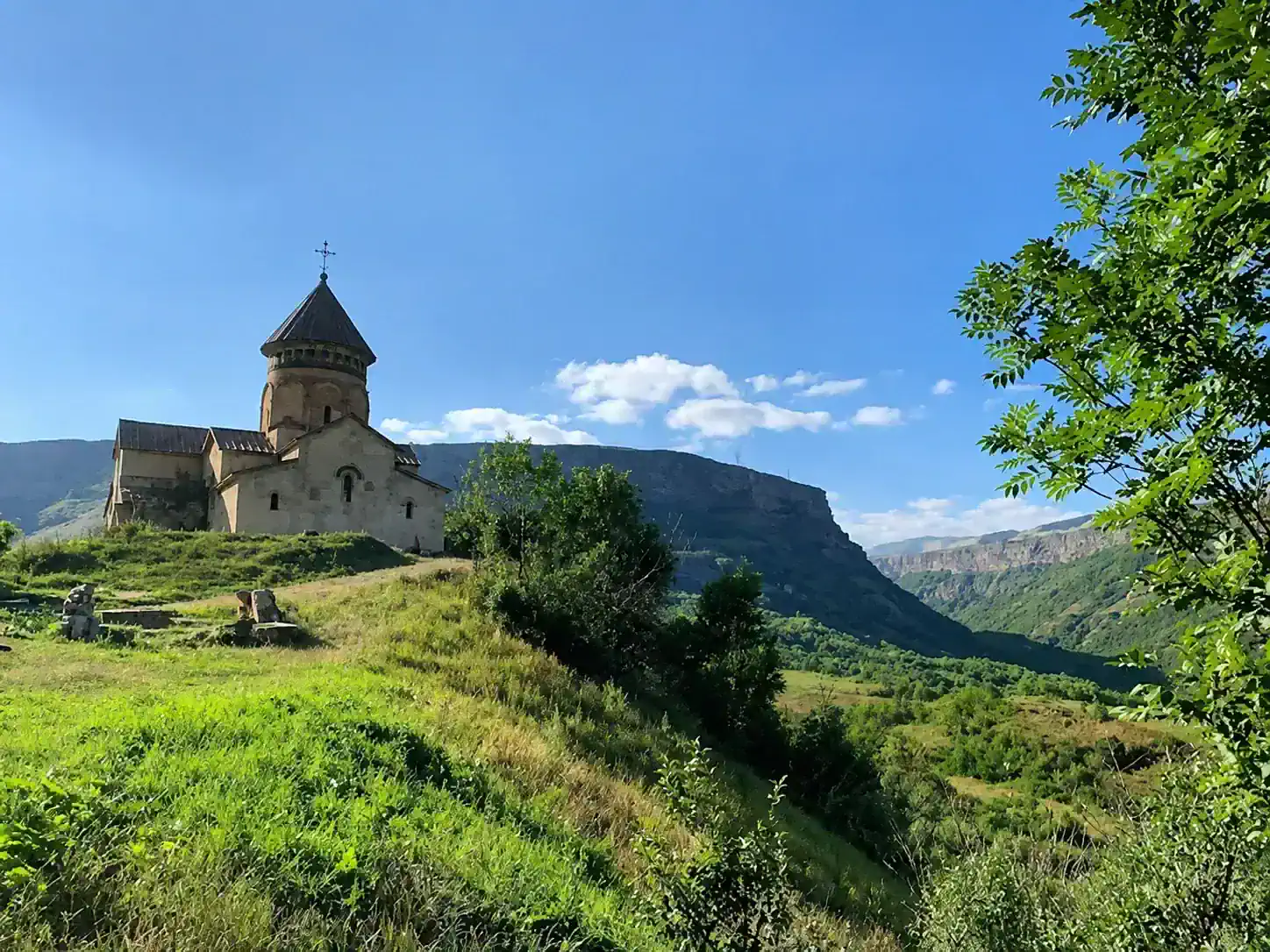
Hnevank is located east of the village of Kurtan in the Lori region, in the gorge on the right bank of the Dzoraget River. It consisted of three churches, a narthex, and residential, economic, and auxiliary buildings. The name of the Hnevank monastery is sometimes translated as "Greek monastery." However, based on the monastery's Georgian inscriptions, it is suggested that Hnevank is not its official name. It came to be known by this name because the monastery had long stood abandoned and desolate.
The oldest structure in the complex is the 7th-century main church. It is rectangular on the outside and has three apses. Side chapels are built on both sides of the main apse. The church's dome rests on two rows of squinches, and the octagonal drum is surrounded by paired half-columns and blind arches.
In the early 13th century, another domed church was built on the southern side of the main church. Its southern entrance is decorated with acanthus leaves, half-columns, and a pointed blind arch. Of the northern single-nave church, only the apse section and the lower courses of the walls have survived.
The builders also employed an interesting engineering technique: large clay jars were placed inside the roofs to reduce the weight of the stone structure. Light yellowish felsite was used in the masonry of the main church.
In the 12th–13th centuries, Hnevank functioned as a Chalcedonian monastery. In 1123, King David the Builder handed it over, along with Lori-Tashir, to the amirspasalar Ivane Orbelian. A Georgian inscription preserved beneath the dome's cornice attests that Ivane's son Smbat renovated the main church in 1154. Between 1186 and 1206, a narthex and an adjoining domed hall were added to the western side of the church.