Traveling solo in Armenia gives you the freedom to spend an afternoon wandering Yerevan's markets, take in the views from a hilltop monastery, or stay longer in a village where the food is too good to rush. In five days, you can experience the country's ancient monasteries, mountain landscapes, local food traditions, and lively city life without trying to cover every corner of the map.
The key is planning your route well. While Yerevan is relatively easy to explore on foot, reaching places like Garni, Geghard, Lake Sevan, and Noravank takes more planning, especially if you are not renting a car. Some destinations are easy to visit independently, while others are more practical to explore on a group tour or with a local driver.
This five-day Armenia itinerary combines the country's best-known landmarks with local experiences, from tasting dried fruit at GUM Market to baking lavash in Garni village and sampling wine in Areni. Along the way, you will find practical tips to help you plan transport and make the most of each day․
Note that this is a five-day highlights itinerary, and you can pick the places you would like to visit. If you want an exact plan for 5 days, you can use our AI tour builder and plan your trip.
Here is what your trip can look like at a glance.
At a Glance: 5-Day Armenia Itinerary
Day | Main destinations | Time needed | Best way to get around |
1 | Yerevan: GUM Market, Matenadaran, Cascade, Vernissage, Republic Square | Full day | Walk and use city transport or taxis when needed |
2 | Etchmiadzin Cathedral, St. Gayane, St. Hripsime, Zvartnots | Most of the day | Public transport and taxis, or a guided tour |
3 | Charents Arch, Garni Temple, Symphony of Stones, Geghard Monastery | Full day | Small-group tour or private driver |
4 | Lake Sevan, Sevanavank, Dilijan, Haghartsin Monastery | Full day; consider staying overnight | Organized tour or private driver |
5 | Khor Virap, Areni-1 Cave, Areni winery, Noravank Monastery | Full day | Organized tour or private driver |
Day 1: Discover Yerevan with markets, music and mountain views
Suggested pace: A full day, mostly on foot. The stops below can be adjusted to your interests. Check opening hours before planning the Matenadaran visit, and move Vernissage to a weekend if you want to see it at its liveliest.
GUM market
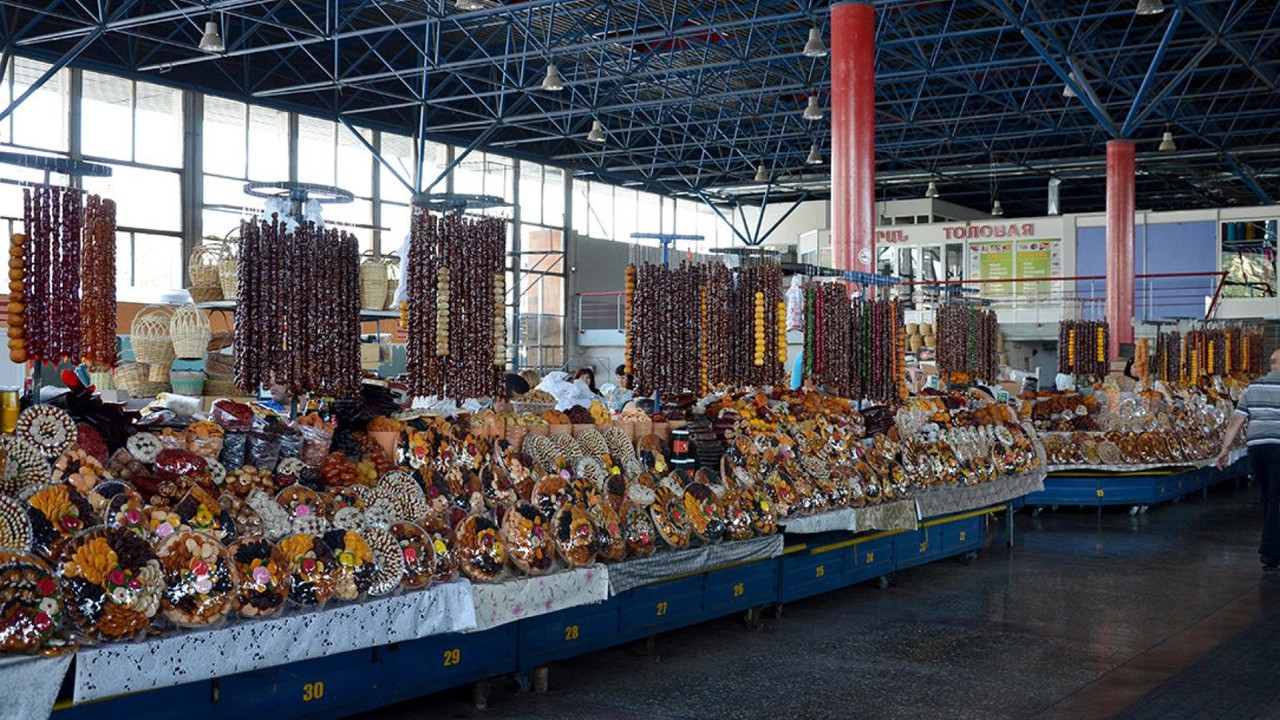
If you’re the kind of traveler who’d rather smell fresh tarragon and taste a dried apricot than read another placard, start your trip at GUM Market. This is Yerevan’s everyday food market, with stalls piled with walnuts, dried fruit leather (tttu), pickled vegetables, honey, and spices, run by people who’ve been selling there for decades.
It is not a market you just walk through. You talk to the vendors, ask for a taste, and buy something small to snack on for the rest of the day. It’s unpretentious, a little chaotic, and tells you more about daily Armenian life than any monument will.
![]()
Blue Mosque & Mashtots Avenue
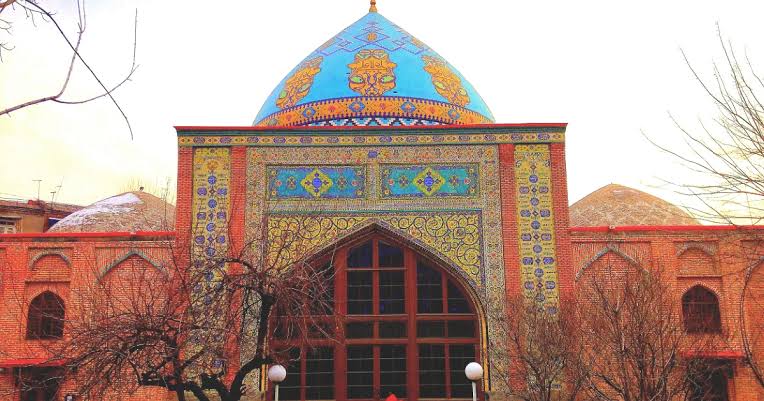
From the market, it’s a short walk to the Blue Mosque, the only functioning mosque left in Armenia and a striking blue-and-turquoise survivor of the 18th-century Erivan Khanate. Built in 1766, it became a history museum under Soviet rule before Iran funded its restoration in the 1990s and reopened it as a mosque. And there is a Persian library now tucked into its courtyard. It is one of the few quiet corners in the city center. As at any active mosque, dress modestly and be ready to remove your shoes if you step onto the prayer carpets.
![]()
Learn more: Yerevan Blue Mosque: a piece of Persia in Armenia
Matenadaran
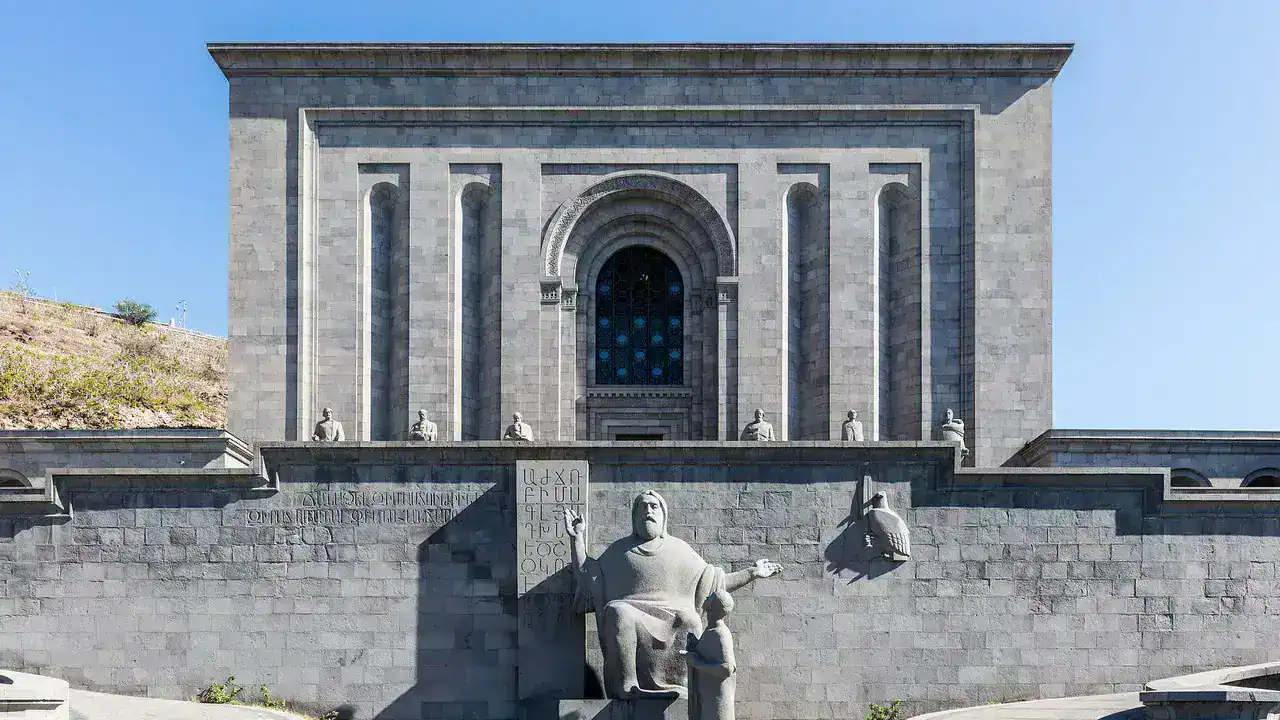
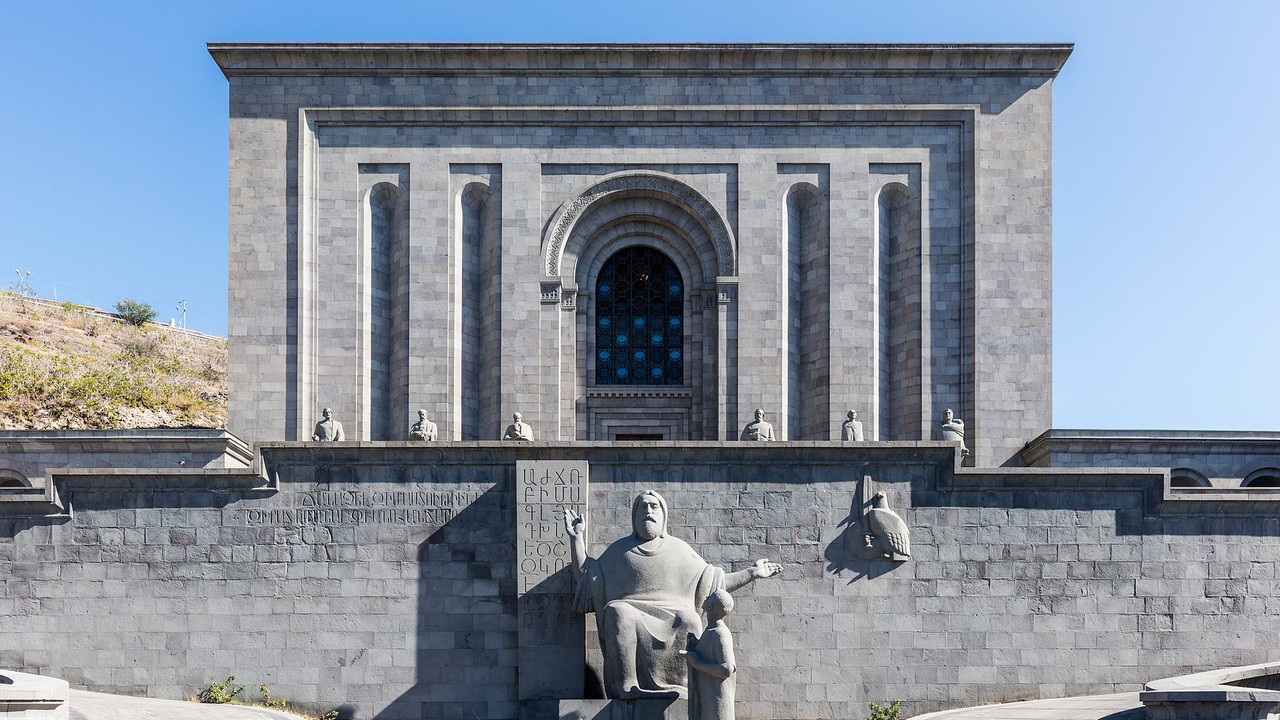
If manuscripts and old books genuinely interest you, block out real time for the Matenadaran. It is one of the world’s richest repositories of ancient and medieval manuscripts.
The building has neo-Armenian style and was designed by Mark Grigorian. The monumental stairs lead to the statues of Mesrop Mashtots and Koryun. On the wall behind the statue, the first Armenian translated sentence “ճանաչել զիմաստութիւն եւ զխրատ, իմանալ զբանս հանճարոյ” which means “To recognize wisdom and guidance; to know the words of the genius,” is engraved.
Here you can see the illuminated gospels up close. It’s open Tuesday to Saturday, 10:00–17:50 (closed Sunday and Monday), with general admission at 2,000 AMD for adults and reduced rates for students and children. Photography rules are stricter for professional cameras, so check at the desk if you’re there for shooting.
![]()
Learn more: Matenadaran
Cascade & Cafesjian Sculpture Garden
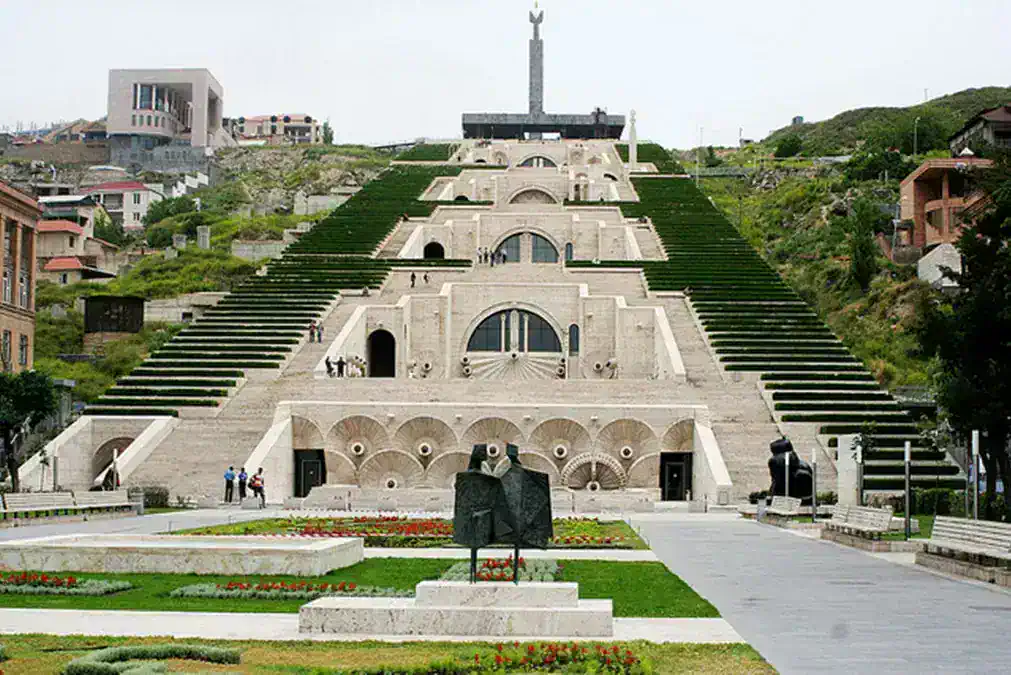
The Cascade is a monumental tuff-and-travertine staircase climbing the hillside north of the center, decades in the making. It started in the Soviet era, stalled through independence and war, and finally finished in 2009 with funding from Armenian-American philanthropist Gerard Cafesjian. You can climb (or take the internal escalators) past the outdoor Sculpture Garden, where works by Fernando Botero, Jaume Plensa, and Lynn Chadwick sit right in the open air, free to walk through. I recommend going in the afternoon if you can and enjoy one of the best views of Yerevan and, on a clear day, Mount Ararat beyond it.
![]()
Learn more: Cafesjian Center for the Arts
Opera House & Swan Lake
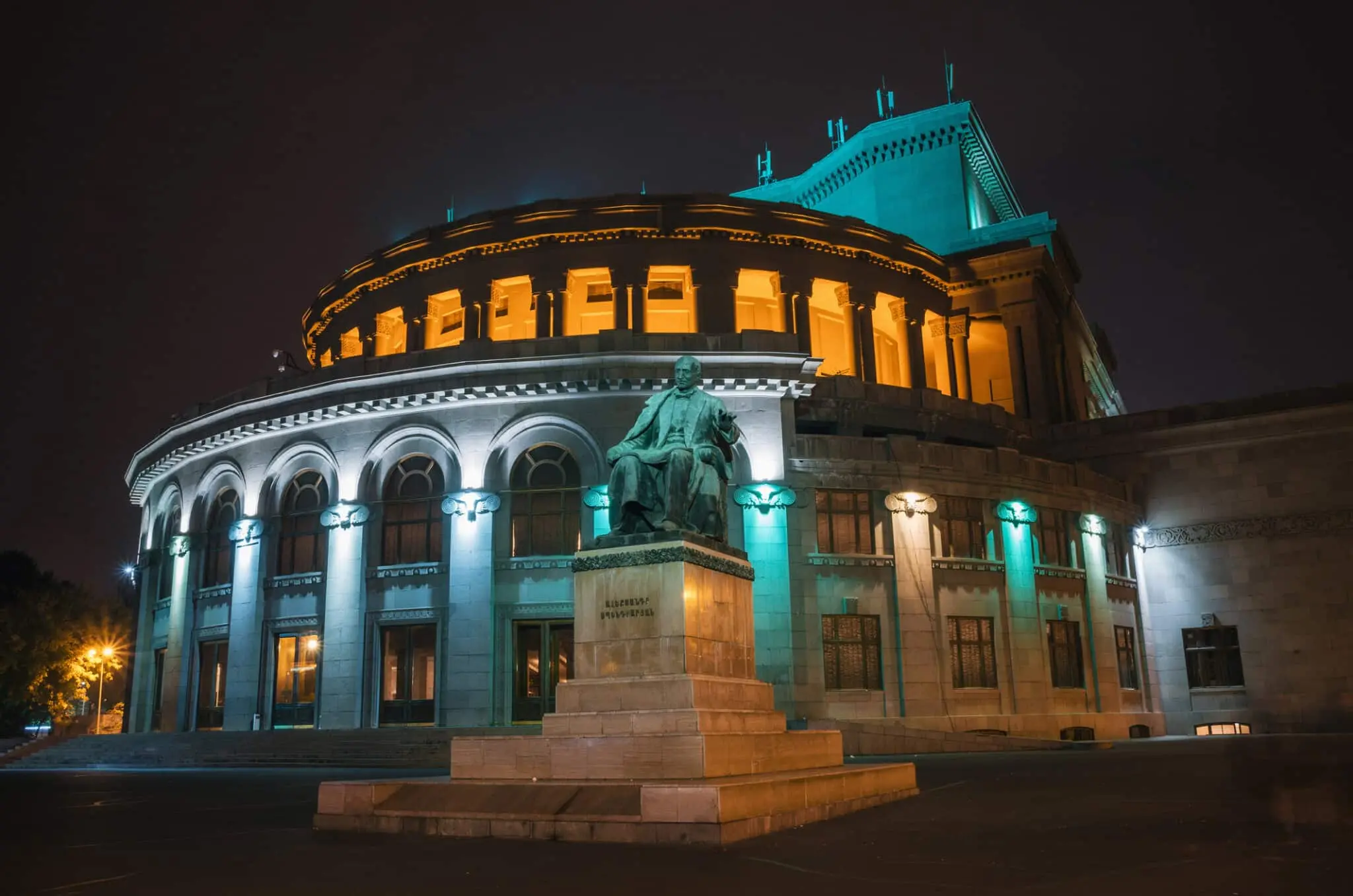
Freedom Square, wrapped around the Yerevan Opera Theatre, is one of the best places to just sit and walk for a few minutes. The Opera was designed by Alexander Tamanian and opened in 1933, and it still stages opera and ballet today. Beside it, Swan Lake , a man-made reservoir shaped to echo Lake Sevan, is a quiet spot by day and a popular evening meeting point once the surrounding cafés fill up.
If you want more than a walk-by, check the Opera’s schedule in advance to check the events.
![]()
Learn more about the Yerevan Opera Theatre
Vernissage Flea Market
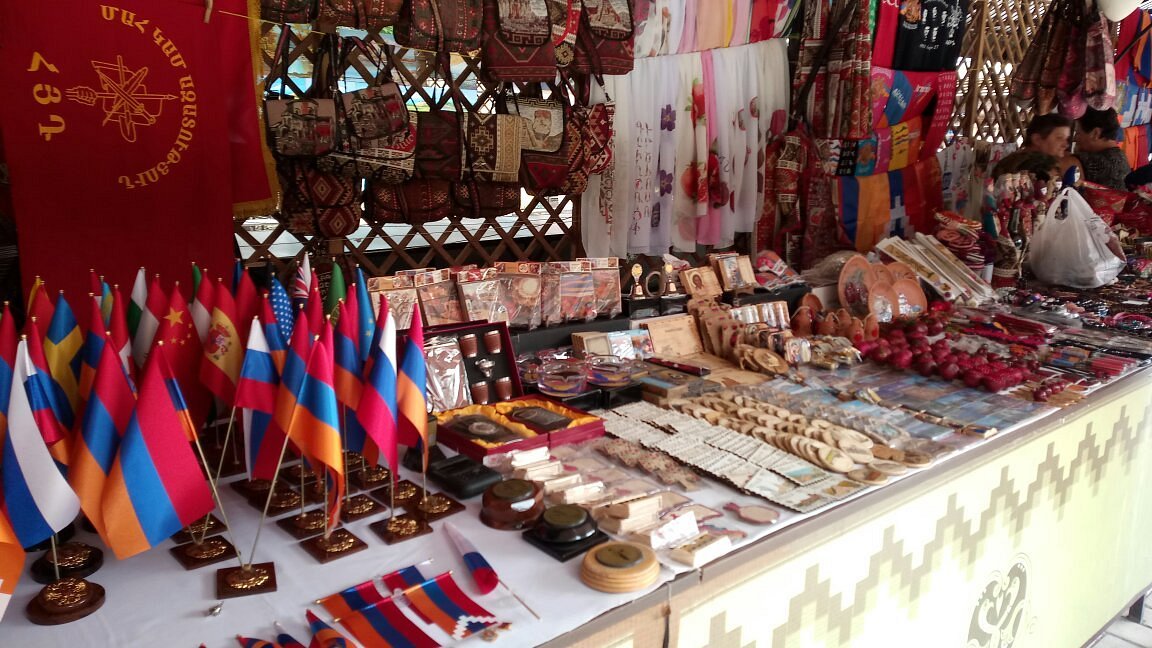
No matter how many times you come back, you can never leave Vernissage empty-handed. It’s Yerevan’s open-air crafts and antiques market, born in the late 1980s when local artists started displaying work near the Artists’ Union, and it has since spread into a sprawling bazaar of carved wood, carpets, old Soviet medallions, jewelry, and instruments, mixed in with tourist souvenirs.
It’s liveliest on weekends, so plan accordingly if browsing without the crowds matters more to you than selection.
![]()
Learn more about Vernissage
Republic Square Singing Fountains
End your first day the way most locals and non-locals do – at Republic Square as the sun goes down. Tamanian designed the square as the city’s civic heart, and its pink-and-black tuff facades still frame it beautifully. The fountains in front were converted into “singing” color-and-music fountains back in the Soviet era and renovated again in 2007. In the warmer months, you will often catch them running with the water lit up and choreographed to music, a genuinely nice way to close out a long day of walking.
Learn more about Republic Square
Day 2: Etchmiadzin: Where Armenian Christianity Began
Suggested pace: A day trip from Yerevan. The churches in Etchmiadzin are close enough to combine on foot, but you will need to plan transport to and from the area and to Zvartnots. If you want to include a brandy tasting, book it ahead and confirm the timing.
Etchmiadzin Cathedral
Etchmiadzin Cathedral marks the spot where, by tradition, St. Gregory the Illuminator had a vision that led King Tiridates III to make Christianity the state religion of Armenia in 301 AD. Hence, making this, by most accounts, the oldest cathedral site in the world and the spiritual seat of the Armenian Apostolic Church ever since.
The current structure was largely rebuilt in the 5th century, with its dome dating to the 17th century after Persian forces plundered the site, and it recently reopened in 2024 after an extensive restoration. It’s part of a UNESCO World Heritage Site along with the churches around it, so allocate enough time to see more than just the cathedral itself.
Learn more about Etchmiadzin Cathedral.
St. Gayane Church
A short walk from the cathedral complex is St. Gayane. Built in 630 AD on the site where the nun Gayane was martyred, it’s a beautifully proportioned domed basilica, with a 17th-century arched portico added later that’s still used as a burial place for senior clergy.
Architecturally, it’s simpler than Etchmiadzin, almost austere, and that’s part of its appeal. It’s part of the same UNESCO inscription as the Mother Cathedral.
Learn more about St. Gayane Church.
St. Hripsime Church
If you only have time for one more church after Gayane, make it Hripsime. Built in 618 AD over the tomb of St. Hripsime, it’s considered the finest surviving example of its architectural type in Armenia — a domed tetraconch so influential that its design shaped churches across Armenia, Georgia, and the Byzantine world for centuries after.
Like the others, it’s part of the UNESCO-listed Etchmiadzin ensemble, and dressing modestly, as at any active Armenian church, is the respectful approach.
Learn more about St. Hripsime Church.
Zvartnots Cathedral ruins
Zvartnots is a bit of a detour on the way back toward Yerevan, and I think it’s worth every extra minute.
What stands today is the skeleton of a 7th-century centrally planned cathedral. Once reportedly it reached around 45 meters and stood for roughly three centuries before collapsing, most likely in an earthquake, and lay buried until excavations began in 1901.
Walking among the column bases and carved capitals, you get a real sense of scale even though almost nothing survives above head height.
Learn more about Zvartnots Cathedral.
Ararat Brandy Factory tasting
The Yerevan Brandy Company, maker of ARARAT brandy, has been distilling here since 1887, when merchants Nerses Tairyan and Vasily Tairov first installed French-style stills on the site of an old fortress.
The factory has operated under the Pernod Ricard group since 1998 and today ships its brandy to dozens of countries. The tour walks you through the aging cellars and blending history before ending, appropriately, in a tasting room where you sample a few different vintages. You can call ahead or book through the factory before showing up.
Learn more about Armenian brandy.
Day 3: Garni, Geghard and Armenia’s Living History
Suggested pace: A full day outside Yerevan. This route is easiest with a small-group tour or a driver, particularly if you want to include Charents Arch, the Symphony of Stones, and a lavash-making experience. Confirm the time and location of any booked activity before you leave.
Charents Arch viewpoint
Charents Arch is a stone archway built in 1957 on a hilltop above the Garni road, dedicated to the poet Yeghishe Charents, who reportedly loved stopping at this exact spot. A line from his poetry, praising Mount Ararat, is carved into the stone, and on a clear morning the view through the arch frames Ararat almost perfectly. It is a quick stop, but it’s the kind of five-minute pause that ends up in everyone’s photos.
Lavash baking in Garni village
Lavash, the thin, UNESCO-recognized flatbread central to Armenian cuisine, is traditionally made by small groups of women working together, rolling dough paper-thin and slapping it against the inner wall of a clay tonir oven, where it bakes in under a minute.
In Garni village, you can join a household for a hands-on baking session, which is as much about the conversation and hospitality as it is about the bread itself. Expect flour on your clothes and probably more food pressed on you than you planned to eat.
Learn more about lavash.
Garni Temple
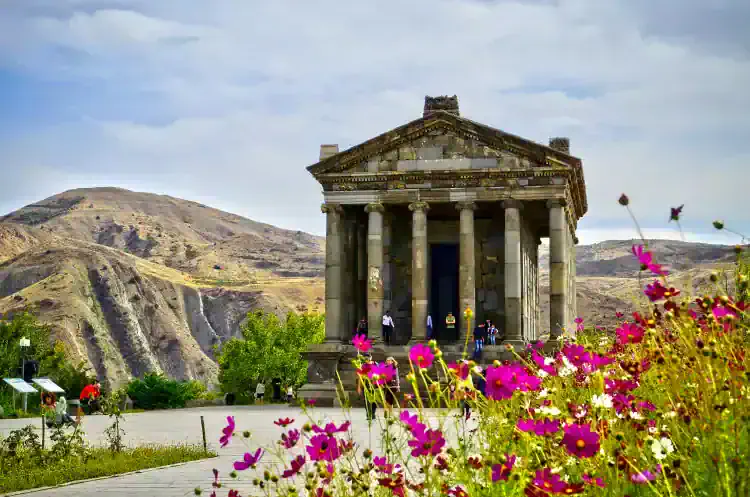
Garni Temple still surprises people who didn’t expect to find a Greco-Roman colonnaded temple in the Armenian highlands. Built around 77 AD, likely under King Tiridates I, and dramatically reconstructed from its original stones after an earthquake toppled it in 1679, the temple sits on a promontory above the Azat Gorge with Mount Ararat visible on a clear day.
It’s open daily except Monday (9:00–17:30, with extended evening hours May through November) for a flat 1,500 AMD entrance fee.
Learn more about Garni Temple.
Symphony of Stones
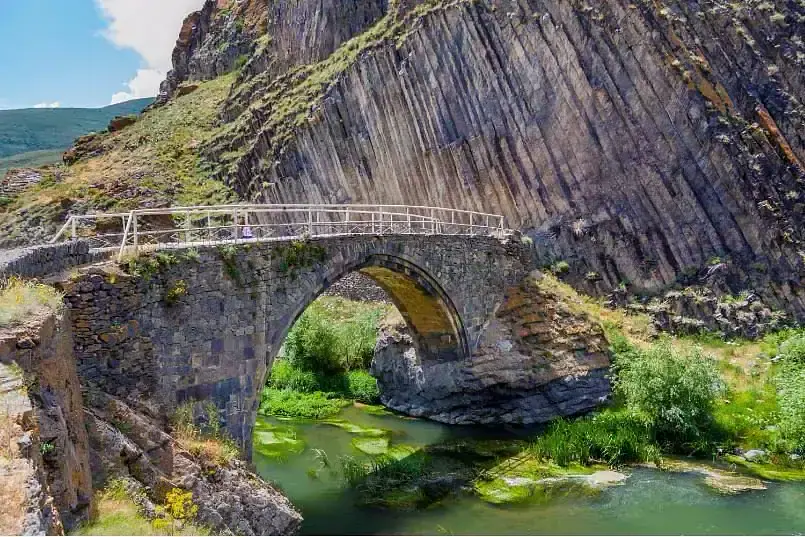
Just below the temple, a short detour into the Azat Gorge brings you to the Symphony of the Stones. It is a wall of tightly packed hexagonal basalt columns that formed naturally as ancient lava cooled slowly over time, and that genuinely does look like a man-made organ-pipe installation at first glance.
A medieval stone bridge crosses the gorge nearby, and if you’ve got more time and sturdier shoes, the valley continues up toward Khosrov Forest and Havuts Tar Monastery.
Learn more about the Symphony of Stones.
Geghard Monastery
Geghard is, hands down, one of the most atmospheric places I bring people in Armenia. Partly carved directly into the cliff face and partly built, the monastery takes its name from the Holy Lance said to have pierced Christ at the crucifixion, once kept here and now held at Etchmiadzin.
The oldest parts trace back to a 4th-century cave church, though what you walk through today — including the extraordinary stalactite-domed narthex — was largely shaped by the Zakarid and Proshyan families from the 13th century onward.
It’s a UNESCO World Heritage Site and still an active monastery.
Learn more about Geghard Monastery.
Tsitsernakaberd Genocide Memorial
I’ll be honest with you: this is the heaviest stop on the whole itinerary, and it should be. Tsitsernakaberd was built in 1967 to honor the 1.5 million Armenians killed in the 1915 genocide — twelve basalt slabs curve around an eternal flame, a split 44-meter stele rises beside it symbolizing the nation’s survival, and a long wall lists the towns and regions where the massacres took place.
The adjoining museum goes deeper into the history, with English, Russian, French, and German tours available.
Learn more about Tsitsernakaberd.
Day 4: Lake Sevan and Dilijan’s Forested Hills
Suggested pace: A long day trip, or a more relaxed overnight trip if your schedule allows. Sevanavank, the lake shore, Dilijan Old Town, and Haghartsin involve several stops. If you want to linger in Dilijan, consider spending the night there rather than returning to Yerevan late in the day.
Sevanavank Monastery
Lake Sevan comes into view well before you reach it, and Sevanavank is the obvious first stop — two 9th-century churches perched on what used to be an island until Soviet-era water diversion lowered the lake by about 20 meters and left the monastery stranded on a peninsula instead.
Founded in 874 AD by Princess Mariam, it was originally a place of penance for monks from Etchmiadzin, and today it’s one of the most-visited sites in the country for exactly the reason you’d guess: the walk up to the churches rewards you with one of the best views over the lake in any direction. Bring a layer. At nearly 1,900 meters elevation, it’s noticeably cooler and windier up here than it was in Yerevan.
Learn more about Sevanavank Monastery.
Lake Sevan shore
If you’re visiting in summer, carve out real time at the lake itself — not just the monastery view, but the shore. Lake Sevan is the largest lake in the Caucasus, sitting at nearly 1,900 meters, and its public beaches, concentrated along roughly 2.5 kilometers of the northern shore, are the closest thing Armenia has to a seaside. Beach season runs through summer.
Learn more about Lake Sevan.
Dilijan Old Town
Driving into Dilijan always feels like a shift in pace — the hills close in, the air cools down, and the town’s old quarter along Sharambeyan Street slows everyone’s walking speed without anyone deciding to.
The houses here, with their gabled tiled roofs and carved oriel windows, have been restored as working craft studios, so you can watch woodcarvers, potters, and metalworkers at their benches rather than just looking at preserved facades.
It sits inside Dilijan National Park, at roughly 1,500 meters, with noticeably cooler summers and snowy winters compared to Yerevan.
Learn more about Dilijan.
Haghartsin Monastery
Tucked into forested hills a short drive from Dilijan, Haghartsin is the kind of monastery that rewards an unhurried visit — the setting does half the work. Built up gradually from the 10th to 13th centuries, its three churches include St. Astvatsatsin, completed in 1281 with a striking sixteen-sided dome, and a 1248 refectory with an unusual intersecting-arch roof that’s rare even by Armenian standards.
The whole complex underwent a major restoration completed in 2011, which is part of why it feels so well kept today, right down to the small bakery and gift shop near the entrance.
Learn more about Haghartsin Monastery.
Day 5: Khor Virap, Areni and the Wine Country of Vayots Dzor
Suggested pace: A long day trip from Yerevan. Khor Virap, Areni-1 Cave, a winery, and Noravank are best visited with transport arranged in advance. Confirm the cave’s access and opening hours and book a winery tasting where required.
Khor Virap
If you only photograph one view in all of Armenia, it’s probably going to be this one. Khor Virap sits on a small hill in the Ararat plain, close enough to the closed Turkish border that Mount Ararat fills the entire horizon behind the monastery on a clear day. This is also where, by tradition, Gregory the Illuminator was held in a pit for thirteen years before converting King Tiridates III and setting in motion Armenia’s adoption of Christianity in 301 AD — you can still climb down into that pit today via a narrow stairway and ladder beneath St. George’s Chapel. Go early in the morning, both for the light and because the clouds that build up around Ararat later in the day can swallow the whole view.
Learn more about Khor Virap.
Areni-1 Cave
Areni-1 Cave is where archaeologists uncovered the world’s oldest known winery in 201. It is a roughly 6,100-year-old wine press and fermentation vat, along with the world’s oldest known leather shoe, found in the same cave system in the Arpa River gorge. It’s an active research site as much as a visitor attraction.
Learn more about Areni-1 Cave.
Areni winery tasting
After the cave, it only makes sense to taste what that six-thousand-year tradition has become. Areni village is the heart of Armenia’s wine country, and family-run wineries here — some operating since the 1990s — offer cellar tours through oak-barrel aging rooms followed by tastings of Areni Noir, Armenia’s signature indigenous red grape, alongside fruit wines like pomegranate.
If you can time your trip for the first weekend of October, you’ll catch the annual Areni Wine Festival, when the whole village turns into one big celebration of the harvest.
Learn more about Armenian wine.
Noravank Monastery
Set against sheer, brick-red cliffs in the Amaghu Valley, the monastery’s standout building is Surb Astvatsatsin, a two-story church from the 1330s with a narrow, cantilevered staircase climbing its outer wall — the final known work of the great medieval architect and sculptor Momik, who’s buried nearby.
As the sun drops, the cliffs behind the monastery turn a deeper red that photos never quite capture the same way twice.
Learn more about Noravank Monastery.
Before You Go: Practical Tips for Solo Travel in Armenia
Where to stay: Yerevan makes a convenient base for exploring the capital and taking day trips to nearby attractions. If you want to spend more time in northern Armenia, consider staying overnight in Dilijan instead of returning to Yerevan after a full day of sightseeing.
Getting around: Central Yerevan is manageable on foot, with public transport and taxis available for longer journeys. Outside the capital, distances between attractions can be substantial, and public transport may not take you directly to every stop. For places like Garni, Geghard, and Noravank, compare the cost of a group tour with hiring a driver or arranging transport independently.
What to pack: Comfortable walking shoes are essential for uneven monastery paths, stone steps, and gorge trails. Bring layers for mountain destinations such as Lake Sevan and Dilijan, even when Yerevan is warm. Modest clothing is a good choice when visiting active religious sites.
Booking ahead: Reserve any winery tastings, guided experiences, and activities that require advance arrangements. Before setting out, confirm opening hours, transport schedules, and the return journey, particularly when visiting rural destinations.
Frequently Asked Questions
What is famous in Armenia?
Armenia carries more historical weight than its size suggests. It’s recognized as the first state in the world to adopt Christianity as an official religion, in 301 AD, under King Tiridates III — a fact that still shapes everything from its architecture to its national identity.
The country holds UNESCO World Heritage Sites: the monasteries of Haghpat and Sanahin, the Monastery of Geghard and the Upper Azat Valley, and the Cathedral and Churches of Etchmiadzin together with the ruins of Zvartnots.
Beyond its monuments, Armenia is known internationally for its duduk (a haunting double-reed woodwind, recognized by UNESCO as a Masterpiece of Intangible Heritage), its khachkars (intricately carved cross-stones, also UNESCO-listed), and lavash bread, whose preparation is itself inscribed on UNESCO’s Representative List.
What are some hidden gems in Armenia?
Once you’ve covered the five days above, a few lesser-visited places are worth building a longer trip around. Tatev Monastery in the south is reached by the Wings of Tatev cable car, which is a Guinness World Record holder as the longest non-stop reversible aerial tramway, carrying you over the dramatic Vorotan gorge in about twelve minutes.
The Debed Canyon in the north hides the UNESCO-listed monasteries of Haghpat and Sanahin, quieter and less crowded than Geghard despite being just as significant. Smbataberd, a half-ruined hilltop fortress near Yeghegis village in Vayots Dzor, gives you sweeping views with almost nobody else around, while Yeghegis itself holds a surprising 13th-century Jewish cemetery tied to the medieval Orbelian dynasty. For something gentler, Lake Parz, a small forest lake inside Dilijan National Park, is an easy, scenic stop with boating and walking trails. And Noratus Cemetery, near Lake Sevan, holds the largest surviving field of khachkars anywhere in the world — nearly a thousand carved cross-stones in one place, with far fewer visitors than you’d expect.
Which month is best to visit Armenia?
It depends on what you want from the trip, but the climate data makes the trade-offs clear. Yerevan is hot and dry in July and August, with average highs around 34–35°C and very little rain — great for long days outdoors, but intense if you’re sensitive to heat.
Spring (April–May) and autumn (September–October) bring milder temperatures, in the high teens to mid-20s°C, and are generally the most comfortable stretches for a multi-day itinerary like this one — October also coincides with the Areni Wine Festival. Winter (December–February) turns cold, with Yerevan’s average lows dropping to around −8°C, and mountain towns like Dilijan get noticeably colder and snowier than the capital year-round.
If swimming at Lake Sevan is on your list, stick to summer — the lake sits at nearly 1,900 meters, so the water stays cool even when the air is warm. In short: late spring and early-to-mid autumn give you the best balance of comfortable weather and fewer extremes, whichever region of the country you’re exploring.
What are the most beautiful villages in Armenia?
A handful of villages stand out for reasons you can actually point to, beyond just a nice view. Dilijan is the most famous, with its old quarter along Sharambeyan Street preserving traditional houses with carved oriel windows and tiled gable roofs, all set inside a national park. Gyumri’s Kumayri Historic District, while technically part of a city rather than a village, deserves a mention here it’s one of the only places in Armenia where you can walk through more than a thousand intact 19th- and 20th-century buildings built from the region’s distinctive red and black tuff stone.
Areni, in the wine country of Vayots Dzor, pairs a 14th-century church designed by the master Momik with a living winemaking tradition and an annual harvest festival. Noratus, beside Lake Sevan, is defined by its extraordinary khachkar cemetery, while Yeghegis carries the quieter distinction of a centuries-old Jewish cemetery.
Planning Your Own Trip
This itinerary is a starting point, not a rulebook. It covers a range of places that give first-time visitors a feel for Armenia, but the pace is ambitious, particularly if you rely on public transport. You can make the trip more relaxed by dropping optional stops, staying overnight in Dilijan, or choosing guided day trips for destinations outside Yerevan.
If you want help turning these ideas into a workable plan, the Armenia Discovery AI Trip Planner can help you organize a day-by-day route around the time you have, the places you want to see, and your accommodation plans. Use it to compare possible routes and check the practical details before you travel.